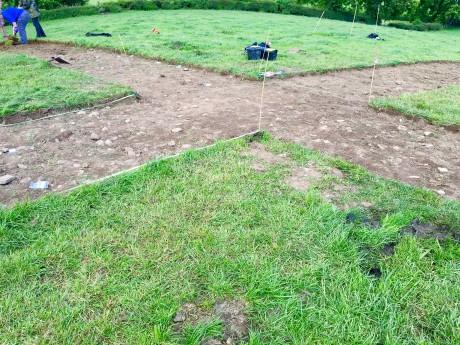
Trenches come in all shapes and sizes. You get long thin ones, and wide open area ones. But you don’t usually get cross shaped ones.
In fact, it’s even less common for a barrow to be investigated like this. They’re usually quartered, and excavated in quadrants leaving a cross shaped baulk in the centre. So why are we excavating the bit that’s usually left in place?
We don’t yet know how wide, or tall, the barrow is, how deep the archaeology goes, or how far it spreads. And even though we’ve managed to crowdfund enough to carry out a two-week excavation, that’s not enough to do the quadrant thing.
So first things first. We need to characterise the barrow. How big is it? What’s the stratigraphy like inside? And to do that, we’re using an intersecting trench.
It’s like an extended evaluation. More than a test trench, less than excavating four quadrants at once. It’s a tried and tested method. One that suits our aims, and our resources.
By the end of it, we should have a clear idea of how much remains of this barrow, and the stratigraphy inside. As a certain someone once said, X marks the spot. In our case, X is the best way to characterise what kind of archaeology we’ve got.