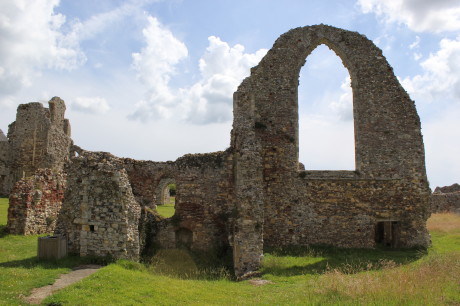
Declaring that he wanted it to be ‘the greatest of all the houses of our order in England’, Ranulph de Glanville founded Leiston Abbey in 1182. If he’d known about the swamps, mosquitoes, floods and fires, he might have been a little more humble…
Minsmere, the site he’d chosen was known locally as ‘the swampy site by the sea’, and his ambitions were quite literally mired by the dire landscape conditions: boggy and so full of mosquitoes that the White Canons were unable to sustain themselves on the land, they became increasingly reliant on endowments for their survival.
Then, in 1362, catastrophic inundation weakened the abbey’s foundations beyond repair; it would have to be relocated and rebuilt and this would be neither cheap, nor easy.
Though they tried to improve the profitability of the existing land holdings to help raise the funds they needed, in the end they had to turn to spiritual incentives to encourage penitents to give alms for the abbey’s reconstruction. Eventually, an almsgiver donated a conveniently located site, surely worth a hefty spiritual reward.
The site, however, was not a blank canvas – previous excavations reveal that it was already occupied by a moated manor.
Nevertheless, they were granted permission to move in 1365 and so the church and other claustral buildings were demolished and rebuilt. They recycled as much of the original 12th century stone as they could, filling in the gaps with 14th century materials, which you can see today.
But even with this economy, dismantling, transporting and rebuilding a structure of this size on a site five miles away must have been a huge financial undertaking, the bulk of which fell to Robert de Ufford who, unluckily as it turns out, had been granted patronage by the crown in 1350.
All in all, a happy ending – a new site, a new building, a new start. Or so it seems. Disaster struck again when, in 1380, a fire destroyed all but the church, saddling the abbey with further debts and putting paid to the grand aspirations of its founder.
The abbey was among those suppressed in 1536 when Henry VIII dissolved the monasteries. The property was then granted to Charles Brandon Duke of Suffolk and later occupied by a farmstead and incorporated into a farmhouse, with the chapel turned into a grain store.
Every abbey has its story, and this one certainly has its. But what of the canons who lived in it? After some initial research, we could find little historical record of their lives, culture and practices beyond the report of a visiting abbot that he had scolded the Norbertines of Leiston Abbey for failing to wear their hoods or tuck in their habits properly.
So, how do we find out more? That is the second chapter of our investigation. On the surround fields, we’ve found earthworks which may give us a clue as to which industry the White Canons undertook. Other features await further archaeological investigation to determine their function. And this will help tell us how the Norbertines used their space, which may give us some clues about what these reclusive canons were up to.